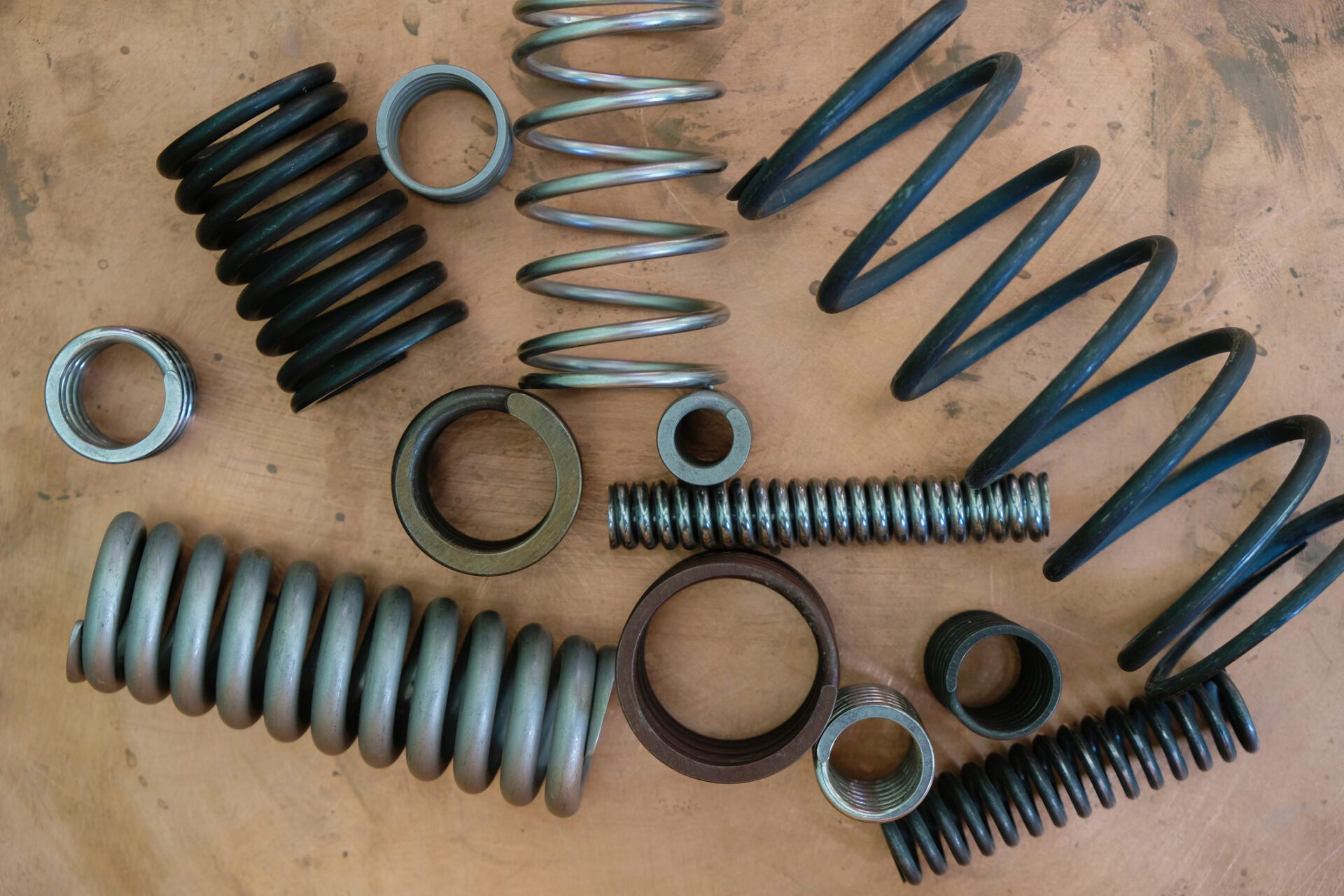
Spring design tolerances are the boundaries that define how much variation in a spring’s dimensions, load, or rate is acceptable.
Get them right, and your spring functions exactly as intended. Get them wrong, and you risk part failure, costly rework, or system-level performance issues.
THE FOUNDATION OF SPRING PERFORMANCE
What Are Spring Design Tolerances?
Spring design tolerances define the allowable range of variation in a spring’s key characteristics. These include physical dimensions like wire diameter, free length, and outer diameter, along with functional properties like spring rate and load at a given height.
Every spring manufacturing operation introduces some variation. Material properties, coiling speed, heat treatment, and tooling wear all contribute to small differences between individual parts. Tolerance specifications set the limits of that variation so you can predict how a spring functions in your assembly.
Understanding spring tolerances starts with knowing two primary categories: dimensional tolerances and load tolerances. Both are critical to spring design and manufacturing, and both must be addressed in your design specifications before production begins.
WHAT THE NUMBERS ACTUALLY MEAN
Dimensional Tolerances in Spring Design
Spring dimensional tolerances govern the physical size and geometry of the spring itself. These are the measurements you verify with calipers, optical comparators, and other inspection equipment.
Wire Diameter
Wire diameter is one of the most tightly controlled dimensions in spring manufacturing. Even a small deviation in wire diameter can shift the spring rate significantly, since spring stiffness is proportional to the fourth power of wire diameter. A spring designed with 0.080″ wire that is produced at 0.078″ will be measurably softer, potentially causing failures in load-sensitive applications.
Standard wire diameter tolerances vary by material and wire gauge, and are typically defined by the wire manufacturer’s specifications. At Western Spring, we source wire to tight diameter tolerances and verify incoming spring material to confirm it meets your design specifications before a single coil is formed.
Free Length
Free length is the unloaded length of a spring and one of the most commonly specified dimensions in compression spring design. Tolerance limits for free length depend on the number of coils, wire diameter, and overall spring length. Longer springs with more coils typically see greater variation in free length than shorter designs.
Free length tolerances directly affect how a spring fits into its housing and how much force it delivers at a given compressed height. When your assembly relies on a specific spring force at a specific position, free length tolerance specifications must be established carefully during the design phase.
A Compression Spring’s Physical Dimensions as a System
A compression spring’s physical dimensions extend beyond wire diameter and free length. Outer diameter, inner diameter, pitch, and the types of compression spring ends all carry their own tolerance requirements. A spring designed for a bore fit must have its outer diameter controlled to prevent binding. A spring designed around a post must have its inner diameter controlled to avoid interference.
The spring’s physical dimensions work as a system. Tolerance limits for any one dimension must be considered in relation to the others to avoid stack-up issues in assembled applications. The spring’s dimensions define what can be built; your system design defines what must be met.
FORCE, RATE & REAL-WORLD PERFORMANCE
Load Tolerances and Spring Rate
Dimensional tolerances set the physical boundaries, but load tolerances define functional performance. Load tolerances specify how much the spring force can vary at a defined test height.
The spring rate, often called the spring constant, is the ratio of force change to deflection. Spring rate tolerances govern how stiff or compliant a spring can be and still meet your design requirements. A variation in spring rate can make a spring stiffer or softer than intended, which directly influences spring performance in your application.
Load tolerances are typically expressed as a percentage of the nominal load. Standard tolerances for spring rate and load often range from ±5% to ±15%, depending on spring type, spring material, and application requirements. Tighter tolerances are achievable, but they require closer process control and typically increase manufacturing cost.
When reviewing your design specifications, consider whether your application truly requires tight tolerances on load or whether standard tolerances will serve your needs. An experienced spring manufacturer can help you evaluate where precision is critical and where you have room to relax requirements without affecting real-world performance.
INDUSTRY BENCHMARKS & BEST PRACTICES
Compression Spring Tolerance Standards
Compression spring tolerance standards are well-established in the spring manufacturing industry. The Spring Manufacturers Institute publishes guidelines that define typical achievable tolerances for compression spring design across a range of wire diameters, spring indexes, and materials. These industry benchmarks give designers a reliable starting point when developing tolerance specifications.
ISO 9001:2015 spring tolerances are part of a broader quality management framework. Western Spring’s ISO 9001:2015 certification means our manufacturing processes, inspection methods, and documentation practices are structured to meet the highest standards of quality and consistency. Every compression spring we produce is subject to documented spring tolerance specifications and full material traceability from raw stock to finished part.
Standard tolerances defined by industry guidelines represent what is reliably achievable in a well-run manufacturing environment. Compression spring design that calls for tighter tolerances than standard requires additional process controls, increased inspection frequency, and often specialized tooling. Understanding the relationship between tolerance requirements and manufacturing capability helps you design springs that are both precise and cost-effective to produce.
When you compare a custom spring to a stock compression spring from a catalog, the difference often comes down to tolerances. Stock springs are manufactured to broader standard tolerances that serve a range of applications. Custom springs, like those produced at Western Spring, are engineered to your exact tolerance specifications from the outset.
Torsion Spring and Extension Spring Tolerances
Torsion spring tolerances add another layer of complexity to spring design and manufacturing. Leg position, angular deflection, and torque at a given angle all carry tolerance requirements. The geometry of torsion spring legs is particularly sensitive to coiling variables, and leg angle tolerances must be set carefully to avoid assembly interference or unintended preload.
Extension spring tolerance considerations include initial tension, hook geometry, and free length. The initial tension in an extension spring is the load required to begin separating the coils, and it can vary based on coiling speed and spring material. Hook geometry affects how the spring loads in use and must be controlled to avoid stress concentrations that can lead to premature fatigue.
Both spring types benefit from the same foundational approach: define what the spring must do in your assembly, then work backward to set tolerance limits that make that performance achievable and repeatable across a full production run.
BEYOND THE COIL
Wire Form Design Tolerances
Wire form design tolerances differ from coil spring tolerances in meaningful ways. Wire forms can take nearly any shape, which means tolerance control requires careful attention to bend angles, radii, and leg lengths across a three-dimensional geometry.
Variation in spring wire dimensions accumulates through each bend in the forming sequence. A wire form with six bends will see more cumulative variation than one with two bends. Managing wire form design tolerances means understanding how each forming operation contributes to the final geometry and where those variations have the greatest impact on function.
BUILT FOR THE MOST DEMANDING ENVIRONMENTS
Spring Tolerances in Aerospace and Medical Applications
Spring tolerances in aerospace applications are among the most demanding in any industry. Aerospace springs must perform reliably across extreme temperature ranges, vibration environments, and load cycles. Tolerance requirements in aerospace spring design often exceed standard commercial limits, requiring tighter process controls, 100% inspection, and full material traceability.
WHERE PRECISION SAVES LIVES
Medical Coil Design Precision
Medical coil design precision is held to equally rigorous standards. Medical coils and springs used in surgical instruments, implantable devices, and diagnostic equipment must meet strict dimensional and functional requirements. A spring that falls outside tolerance in a medical device can affect patient outcomes. At Western Spring, our medical spring and coil manufacturing follows documented quality protocols designed to meet the exacting demands of that industry.
THE COST OF GETTING IT WRONG
How Spring Tolerances Affect Cost and Manufacturability
One of the most practical aspects of spring tolerance analysis is understanding the relationship between tolerance tightness and production cost. Tighter tolerances mean more frequent inspection, higher scrap rates, more precise tooling, and slower production speeds. All of these factors influence the cost of a finished spring.
The spring manufacturing industry operates on a clear principle: specify the tolerance your application requires, not the tightest tolerance you can imagine. Unnecessary precision adds cost without adding value. A reliable spring is one that meets its functional requirements consistently, not one with the smallest possible tolerance band.
Tolerances in spring manufacturing should be established in collaboration with your manufacturer before the design is finalized. The manufacturing process imposes real limits on achievable tolerances, which means designing a spring that calls for limits beyond what standard manufacturing processes can reliably hold may lead to yield problems, cost overruns, and delivery delays.
Advanced spring design software, like the tools used at Western Spring, helps engineers evaluate tolerance stack-up during the design process. Our team uses computerized force and length testing to verify that every spring meets your spring tolerance specifications before beginning production.
START SMART, AVOID COSTLY REVISIONS
Designing Springs with Precision from the Start
Designing a spring with precision starts at the concept stage. When you define a spring’s wire diameter, free length, spring rate, and physical dimensions early in the design process, you create a foundation for realistic and manufacturable tolerance specifications.
Several principles guide advanced spring design and manufacturing:
- Match tolerance requirements to application needs. Tight tolerances in a non-critical dimension add cost without benefit.
- Consider the effect of spring material on tolerances. Different alloys carry different tensile strength ranges, which affect spring rate consistency across a production lot.
- Account for variation in a spring’s rate from part to part. Variation in spring rate is a normal product of the manufacturing process; the key question is how much variation your system can absorb.
- Plan for the manufacturing process. Spring design and manufacturing work best when engineers understand what coiling and forming operations can reliably produce at volume.
- Use Spring Manufacturers Institute guidelines and ISO 9001:2015 spring tolerances as a baseline when setting tolerance specifications for new designs.
Whether you’re designing an industrial spring for heavy equipment, a precision aerospace component, or a medical device, every successful spring starts with clear spring design tolerances and a manufacturer equipped to meet them.
YOUR SPRING MANUFACTURING PARTNER
Partner with Western Spring Manufacturing
Spring tolerance specifications are only as good as the manufacturing process behind them. An experienced spring manufacturer with the right equipment, quality systems, and engineering knowledge can consistently meet your tolerance requirements across both prototype and full production volumes.
Western Spring Manufacturing has been producing custom springs and wire forms in Minnesota for four generations. We serve customers across aerospace, agriculture, automotive, defense, industrial, medical, and maintenance and repair applications. From compression springs and torsion springs to extension springs, flat springs, medical coils, and custom wire forms, we engineer every part to your exact spring manufacturing tolerances.
Ready to discuss your spring design tolerances? Contact Western Spring Manufacturing today to request a quote or speak with one of our engineers. We are here to help you get every dimension right, from your first prototype to your full production run.