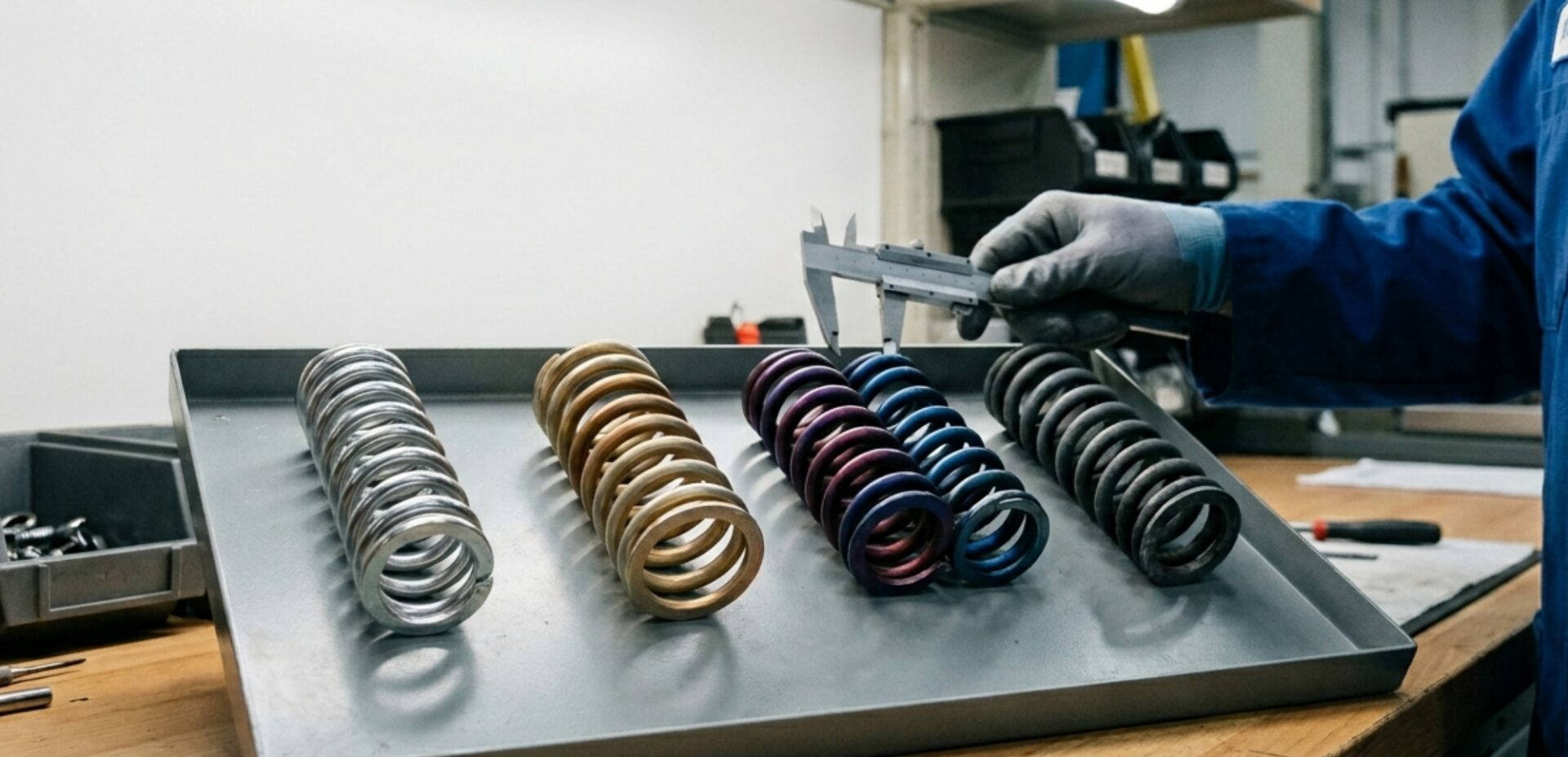
If you’ve inspected a batch of recently heat-treated springs and noticed colors shifting from bright silver to straw, gold, blue, or even dark brown, you’re looking at heat tint, and it’s more common than you might think.
Heat tint is the visible discoloration that develops on the surface of metal springs after they’ve been exposed to elevated temperatures during stress relieving or other forms of heat treatment. It’s one of the most frequently misunderstood effects in spring manufacturing, and it tends to raise questions from quality inspectors and buyers who expect visual uniformity across a batch.
The Science Behind the Color
The Causes of Heat Tint in Springs
Understanding heat tint in spring coils starts with a simple fact: color change is a surface phenomenon driven by light refraction, not a symptom of spring failure or improper processing. The spring’s hardness, tensile strength, free length, and mechanical properties remain entirely unaffected.
How Oxidation and Corrosion Create Color on Metal Springs
When a spring is formed through cold forming: bending, coiling, and shaping wire under mechanical stress, the metal accumulates internal stresses throughout the microstructure. To relieve those internal stresses and stabilize the spring’s dimensions, the part must go through a controlled heating and cooling cycle known as stress relieving.
During that process, oxygen in the furnace atmosphere reacts with iron, chromium, and other alloy elements on the surface layer of the metal. This produces a microscopic, transparent chromium oxide or iron-oxide film on the surface. The result is a protective oxide layer, but one thin enough to create an optical effect rather than visible scaling.
That effect is light interference. As light passes through the ultra-thin oxide layer, it reflects off both the top surface and the steel underneath. Depending on the thickness of that oxide film, specific wavelengths of light are amplified or cancelled, producing the gold, straw, blue, or brown color changes you see on heat-treated springs.
This is the same physics behind soap bubbles and oil slicks. The color isn’t a pigment. It’s a measurement of oxide thickness expressed as visible light.
How Temperature Controls the Tint
The color of heat tint relates directly to temperature. Springs treated at low temperature ranges tend to show light straw or pale yellow tones. As temperature climbs into higher ranges, the oxide layer thickens and colors shift through gold, then brown, then violet, then blue, and eventually into gray or black at very high-temperature exposures.
For most common spring applications, stress relieving happens well within the straw-to-blue range. The tint you get depends on the specific spring material, the time at temperature, and how efficiently the furnace atmosphere delivers heat to each individual coil.
Why Heat Tint Varies
Spring Manufacturing Heat Tint Issues
The Role of Conveyor Ovens in Production
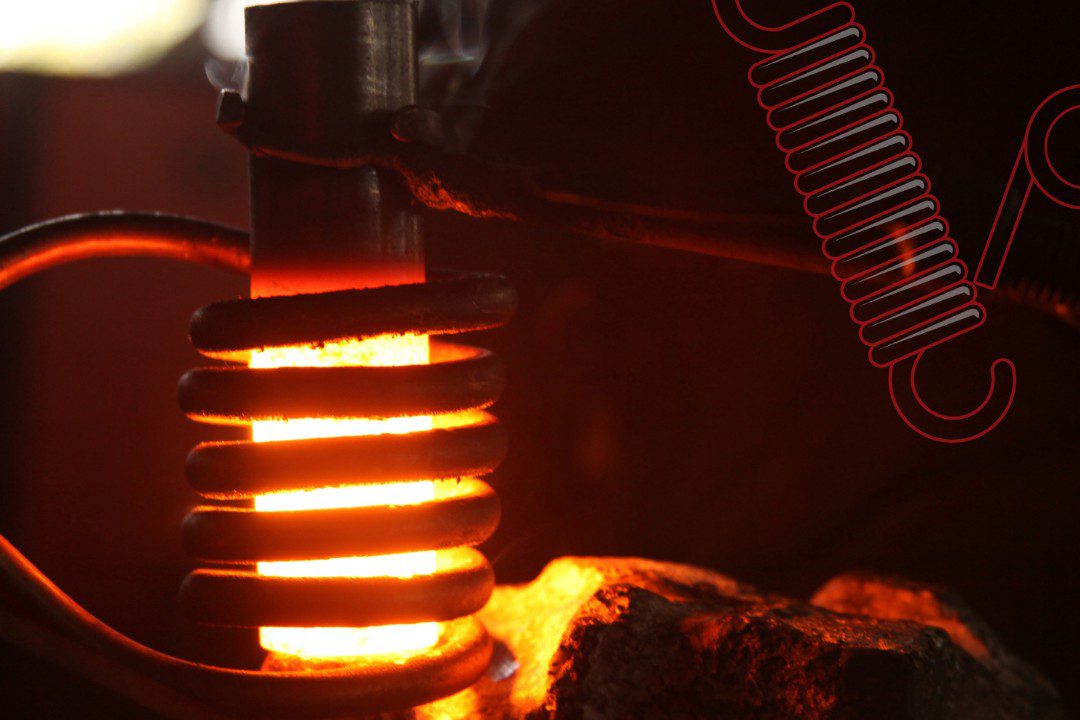
In high-volume spring manufacturing, continuous conveyor ovens are the standard production method. Springs travel on a belt through a heated tunnel, receiving consistent thermal exposure as they pass from entry to exit. This method delivers reliable throughput and repeatable heat treatment times, but it doesn’t eliminate heat tint variation.
Even with a perfectly calibrated oven, two batches of springs made from the same material specification can come out with noticeably different tints. The root cause isn’t the oven. It’s the raw material.
How Different Material Lots Drive Discoloration
Steel is produced in batches (called heat lots) at the mill. Each heat lot reflects its own chemical composition within the specified tolerance range for that grade. Those tolerances allow for minor fractions of a percent of variation in elements like chromium, nickel, manganese, and carbon.
Those fractions matter when it comes to heat tint. One lot of spring steel might oxidize more aggressively at 500°F than the next lot processed under identical conditions. The surface residual oils from the wire-drawing process, combined with prior atmospheric exposure before the wire reaches your spring manufacturer, also influence how quickly and thickly the oxide forms.
This is why heat discoloration in metal springs is nearly impossible to fully control without also controlling atmospheric conditions inside the furnace, and why color consistency across large production runs is more of an exception than a rule.
Heat Tint by Spring Material
How Different Spring Materials and Alloys Are Affected
High-Carbon Steel and Music Wire
Music wire (ASTM A228) is a high-carbon steel known for its high tensile strength and consistent elasticity. During stress relieving, carbon steel springs typically show light straw or golden tones at standard treatment temperatures. Carbon steel lacks chromium, so the oxide forming on its surface layer is primarily iron-oxide, which produces a thinner and more predictable film than chromium-bearing alloys.
That said, carbon steel springs are still subject to lot-to-lot variation in surface condition and residual mill oils, which means color uniformity across large runs isn’t guaranteed.
Stainless Steel Springs
Stainless steel grades like 302, 304, and 316 all carry chromium content that supports excellent corrosion resistance. When those grades are stress-relieved, chromium reacts with oxygen to form chromium oxide on the surface. The resulting tint can range from light gold to blue depending on the temperature and time.
The 17-7 PH (Precipitation-Hardening) stainless steel grade is the most well-known example of inconsistent heat tint in spring manufacturing. To reach its full mechanical properties, 17-7 undergoes an age-hardening process called Condition CH900, which heats the material to 900°F for one hour to precipitate-harden the alloy. At 900°F, oxide formation is aggressive and highly sensitive to surface chemistry. One heat lot might produce a clean, uniform bright gold across the entire batch. The next lot, treated identically, might show mottled brown, violet, or blue with no clear pattern. This is not a quality issue. It’s a predictable outcome of precipitation hardening at that temperature range.
17-7 is valued for its corrosion resistance, so engineers sometimes worry that heat tint signals surface degradation. It doesn’t. The protective oxide layer on stainless steel actually forms naturally on the metal and contributes to its corrosion-resistant character. A blue 17-7 spring performs the same as a gold one.
Alloy Steel: Chrome Silicon and Chrome Vanadium
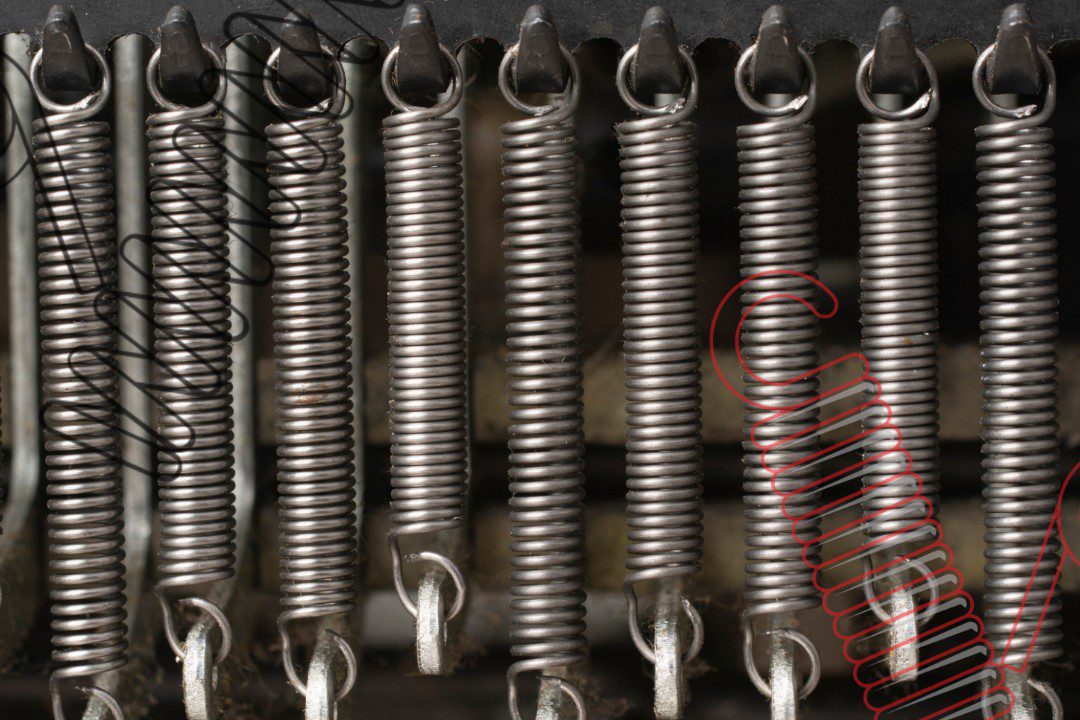
Alloy steel grades like chrome silicon (ASTM A401) and chrome vanadium (ASTM A231) are designed for high-stress applications, including automotive valve springs, suspension systems, and defense components. Chrome vanadium has largely been replaced by chrome silicon in most modern applications due to its superior performance under shock loads and operating conditions at higher temperatures.
Both of these alloy steels are cold drawn and oil-tempered before fabrication, arriving pre-hardened, and may receive an additional stress-relieving cycle after coiling. The chromium content in these grades means they’re susceptible to the same oxide formation physics as stainless steel, though at a different rate. Springs made from chrome silicon or chrome vanadium that are stress-relieved after cold forming will typically show straw or light golden tones. The treatment temperatures for these materials are often lower than the 900°F threshold used for 17-7, so color shifts tend to be less dramatic, and batch-to-batch variation still occurs based on heat lot chemistry.
Nickel-Based Alloys and Inconel
For springs operating in truly extreme environments, Inconel and other nickel-based alloys are the material of choice. Grades like Inconel 600, 625, and X-750 are used in aerospace, defense, and chemical processing — 600 primarily for its corrosion resistance, while 625 and X-750 are rated for service temperatures exceeding 1,000°F.
Nickel-based alloys form a stable, dense oxide layer at high-temperature exposures that’s more protective than the oxide that forms on carbon steel. The heat tint on Inconel springs can range from light gold to dark blue or even black depending on the treatment cycle. That darker surface layer is expected and normal. It’s part of what makes these alloys perform in harsh spring application environments.
Oil-Tempered Steel
Oil-tempered steel springs are pre-hardened during wire drawing via a quench-and-temper process before they’re ever formed into a coil. When these springs undergo stress relieving post-coiling, the residual surface oils from the oil quenching process interact with furnace atmosphere and contribute to more visible and variable heat tint compared to clean drawn materials. Darker tones are common with oil-tempered wire.

Discoloration & Performance
Does Heat Discoloration Affect Spring Performance?
The short answer: no.
Heat tint is a surface-layer effect. The oxide film responsible for color changes is measured in nanometers, far too thin to alter dimensional tolerance, tensile strength, spring’s hardness, deformation resistance, fatigue failure thresholds, or any other mechanical property. A blue spring and a gold spring cut from the same coil of spring steel, treated in the same oven, will have identical spring performance across their service life.
This is a point worth repeating clearly: discoloration from heat treatment is not an indicator of a defect. It’s proof that the spring went through the stress-relieving thermal process that prevents residual stresses from causing long-term deformation or premature spring failure.
The one area where heat tint does matter is aesthetics. But for most industrial spring application environments: agricultural equipment, automotive systems, defense components, and industrial machinery, surface color is irrelevant. What matters is that the spring holds its free length, maintains the correct load at height, and survives its expected cycle life.
When Heat Tint Is a Problem
When Appearance Matters: Minimizing Heat Tint During Production
Spring Applications Where Visual Uniformity Is Required
There are cases where heat discoloration in metal springs becomes a concern. Medical devices, visible consumer product components, and certain aerospace assemblies may have cosmetic requirements that standard conveyor processing can’t reliably meet.
In those cases, the discoloration isn’t a functional issue. It’s a contractual or customer-expectation issue. Minimizing heat tint during production requires removing the variable that creates the tint in the first place: atmospheric oxygen.
Batch Heating in Vacuum or Inert Atmosphere Ovens
The solution is controlled heating in a vacuum batch oven or an inert-atmosphere furnace. By evacuating oxygen from the sealed chamber, or purging it with inert gas like nitrogen or argon, the spring surfaces can’t form an oxide layer during the heat treatment cycle. Springs come out bright and silver, with no color changes.
This process is often called “bright annealing”, though the specific thermal cycle for springs differs from a full anneal. The key distinction is that annealing fully softens the material to increase ductility, while stress relieving at low temperature preserves the spring’s hardness and tensile properties. Vacuum or inert-atmosphere processing achieves the cosmetic result of annealing without the mechanical consequence.
The Trade-Off in Cost and Lead Time
Batch heating is significantly more labor-intensive than continuous conveyor production. Each load requires manual staging of parts into a sealed chamber, cycle tracking, vacuum purging or gas purging time, and controlled cool-down before the chamber can be opened. This eliminates the throughput advantages of a conveyor line.
The result is a notable increase in per-unit cost and often longer lead times. If your spring design requires bright, uniform appearance, the conversation with your custom spring manufacturer needs to happen at the quoting stage, not after production starts.
The Role of Heat Treatment in Long-Term Spring Durability
Heat tint sometimes gets framed as a side effect of heat treatment: something to manage or eliminate. But it’s worth stepping back to recognize the role of heat treatment in why springs perform reliably in service.
Springs made from high-carbon steel and alloy steels are cold formed: the coiling and bending process introduces significant internal stresses into the microstructure. Those residual stresses, if left unaddressed, cause springs to relax under load and shift their free length over time, a phenomenon called stress relaxation or set. In severe cases, they can accelerate fatigue failure.
Treating springs with a controlled stress-relieving cycle drives out those internal stresses, stabilizes the spring design dimensions, and enhances spring durability throughout service life. Shot peening is another surface treatment sometimes used alongside or after heat treatment to introduce beneficial compressive residual stress at the surface layer, further improving fatigue performance.
Heat tint is simply the visible marker that the thermal process happened. It’s proof of treatment, not a symptom of a problem.
Questions? We Have Answers.
What You Should Know About Heat Tint in Spring Coils
Heat tint is a normal, expected byproduct of heat treatment in spring manufacturing. It results from the oxidation of surface elements, particularly iron and chromium, when metal springs and wire forms are exposed to elevated temperatures in an oxygen-containing atmosphere.
Color variation from batch to batch reflects differences between steel heat lots, not differences in oven performance or spring quality. Materials like 17-7 stainless steel are especially prone to inconsistent tinting due to the high-temperature nature of precipitation hardening. Alloy steels, music wire, oil-tempered wire, and nickel-based alloys each respond differently to the same thermal exposure, producing different tint profiles that are entirely predictable for their material type.
For most spring application environments, heat tint is irrelevant to spring performance. For applications where cosmetic uniformity is required, vacuum or inert-atmosphere batch processing offers a path to bright, consistent surfaces, at a higher cost and longer lead time.
If you’re sourcing springs for a new application and have questions about heat treatment, spring materials, or whether your tolerances require special processing, Western Spring’s team is here to walk through your spring design with you. Explore our guide to choosing the right spring materials, or contact us directly to start your project with a free design and production review.