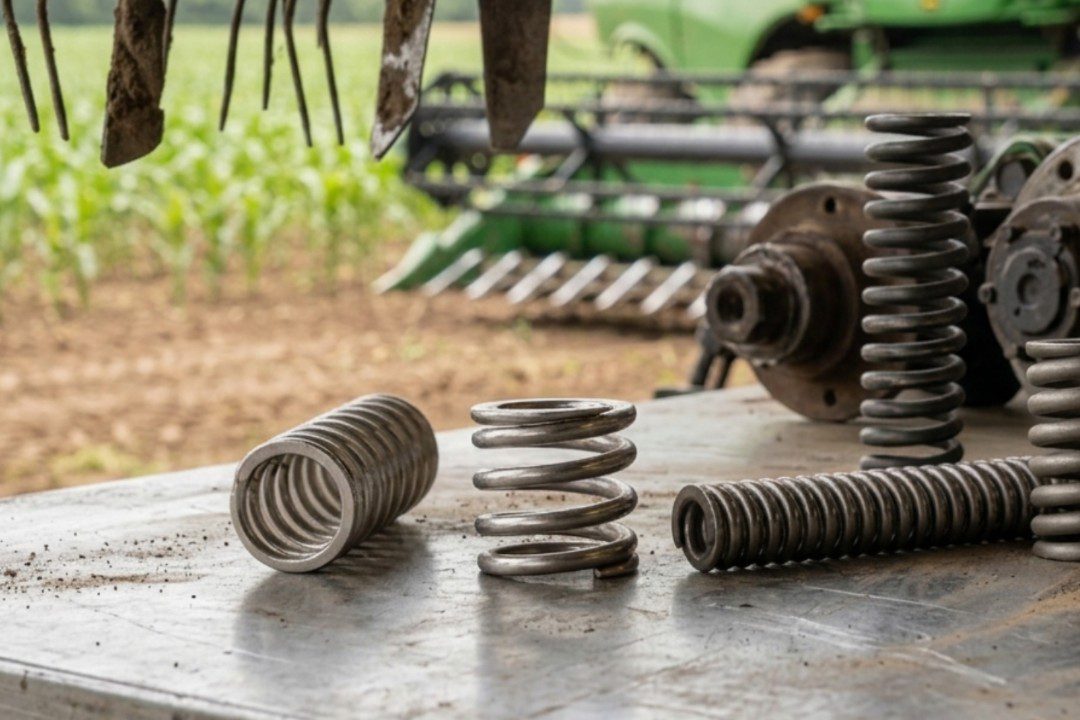
Agriculture puts mechanical components through conditions that few other industries can match. From the vibration of a tractor engine to the shock absorption demands of a planter pressing seed into rocky soil, springs are at work in nearly every system on the farm. Agricultural spring design must account for a range of challenges that push standard spring materials and geometries to their limits.
At Western Spring Manufacturing, we engineer custom agricultural springs that meet the stringent requirements of farm machinery and equipment operating in some of the most demanding environments on earth. This article breaks down the core challenges in agricultural spring design and explores how precision engineering, material selection, and innovative manufacturing processes produce springs that perform reliably season after season.
Quality Barriers & Challenges
The Unique Demands of Farm Machinery
Agricultural equipment operates under conditions that combine heavy loads, constant vibration, abrasive debris, chemical exposure, and wide temperature swings. A spring that performs well in a controlled industrial setting may experience rapid deformation or failure when placed inside a planter, combine, or tillage system. Understanding why agricultural spring performance issues arise starts with recognizing the conditions these components must endure.
Springs in agricultural applications are frequently exposed to:
- Soil, sand, and crop debris that accelerates surface wear
- Fertilizers, pesticides, and herbicides that degrade certain metal coatings
- Moisture cycles that promote corrosion on unprotected spring wire
- Impact loads from rocks, roots, and uneven terrain
- Seasonal storage followed by high-demand operation
Each of these factors influences how a spring is designed, what material it’s constructed from, and how it is finished before leaving the production floor.

Common Agricultural Spring Failures
Spring failure in agricultural equipment rarely happens without warning, but the warning signs are easy to miss during a busy planting or harvest season. Common agricultural spring failures include:
Fatigue Cracking: Repeated stress cycles cause microscopic cracks to form and grow, eventually leading to fracture. This is common in extension springs and torsion springs subjected to constant loading and release during operation.
Corrosion-Induced Brittleness: When spring wire loses its protective coating due to chemical exposure or abrasion, the base metal becomes vulnerable. Corrosion pits act as stress concentrators, dramatically reducing the spring’s ability to withstand load without failure.
Permanent Deformation: Springs that are loaded beyond their design range experience plastic deformation, meaning they no longer return to their original length or position. In agricultural applications, this frequently occurs when equipment encounters an unexpected obstacle in the field.
Surface Wear: Abrasive particles from soil contact degrade spring surfaces, reducing the cross-sectional area of the wire and weakening the component over time.
Recognizing these failure modes is the first step toward designing agricultural springs that avoid them.
Challenges in Agricultural Spring Design
Environmental Exposure and Corrosion Resistance
Corrosion is one of the most persistent challenges in agricultural spring design. Springs mounted on tillage equipment, planters, and sprayer systems are exposed to moisture and agricultural chemicals throughout the growing season. After harvest, they may sit in an unheated shed through a harsh winter, then return to service the following spring with no inspection or maintenance.
Material selection plays a central role in addressing corrosion. High-carbon steel wire is a common choice for its strength and cost efficiency, but it requires protective coatings to perform reliably in wet, chemical-rich environments. Stainless steel spring wire offers excellent corrosion resistance and is preferred in applications where chemical exposure is intense or consistent. Phosphate coatings, zinc plating, and powder coat finishes each provide varying levels of protection depending on the application requirements.
Spring designers must evaluate the trade-offs between material cost, corrosion resistance, load capacity, and fatigue life when specifying materials for agricultural springs. A compression spring designed for a fertilizer application system has different material requirements than a torsion spring used in a seed meter mechanism, even if both operate on the same piece of equipment.
Heavy Loads and Shock Absorption
Agricultural machinery and equipment generate load conditions that vary widely and often unpredictably. A planter running across a flat, prepared seedbed places consistent, moderate loads on its row unit springs. That same planter hitting a ridge or a buried rock generates an instantaneous spike load that the spring system must absorb without permanent deformation or fracture.
Designing durable springs for agriculture means engineering for both the expected load cycle and the worst-case impact event. This requires:
Accurate Load Specification: Spring designers work from equipment manufacturer data and field observations to define the full range of forces a spring will experience. Underestimating peak loads leads to premature failure, while overestimating produces springs that are heavier and stiffer than necessary.
Material and Wire Sizing: The diameter of the spring wire, the number of coils, and the overall spring geometry all determine how much energy a spring can absorb and release without exceeding its elastic limit. Heavier wire provides greater load capacity but reduces the spring’s ability to flex through a wide range of motion.
Shock Absorption Geometry: In applications where impact loads are frequent, spring design may incorporate progressive rate characteristics, meaning the spring becomes stiffer as it is compressed. This allows the spring to absorb light loads with flexibility and heavy loads with increased resistance, improving performance across the full range of field conditions.
Seasonal Use and Fatigue Life
Unlike industrial springs that may operate continuously year-round, agricultural springs experience intense seasonal use followed by extended periods of inactivity. This cycle creates its own set of challenges. Springs that sit under load during storage experience stress relaxation, gradually losing their ability to maintain design force. Springs that are stored without protection accumulate corrosion that compromises their integrity before they ever return to work.
Precision spring design for agriculture accounts for the full seasonal cycle, not just the active operating period. Material selection, surface treatment, and dimensional tolerancing all contribute to ensuring that a spring installed on a planter in May will still meet its performance requirements the following April.
Fatigue life testing is a critical component of the design process. Springs intended for agricultural equipment are tested through simulated load cycles that replicate field conditions, providing data on expected service life and informing design improvements before the product reaches production.
Custom Solutions For Quality & Precision
Spring Design for Agriculture
Generic, off-the-shelf springs are rarely the best solution for agricultural equipment. The variability of field conditions, equipment designs, and operating requirements means that custom agricultural springs typically outperform standard catalog components in both reliability and longevity.
Custom spring design begins with a thorough understanding of the application. Western Spring Manufacturing works with agricultural equipment designers and maintenance teams to define load requirements, dimensional constraints, environmental conditions, and expected service life. From that foundation, we select materials, specify geometry, and develop a manufacturing process that produces springs optimized for the application.
Various types of springs are used in agricultural equipment. Compression springs are used in row unit down-force systems, seed meter mechanisms, and equipment suspension components. Extension springs are used in linkage systems, toolbar attachments, and closing wheel mechanisms. Torsion springs provide rotational force in seed dispensing systems, row cleaners, and gauge wheel assemblies. Each spring type brings its own design considerations, and selecting the right type for a given application is as important as specifying the correct material and dimensions.
Precision Manufacturing for Agricultural Spring Performance
Precision spring design for agriculture requires manufacturing processes that consistently produce springs within tight dimensional tolerances. A compression spring that varies even slightly in free length or spring rate across a production run can introduce inconsistency into equipment performance, affecting seed placement depth, down-force uniformity, or row unit response.
Western Spring Manufacturing uses state-of-the-art CNC coiling equipment and computerized force and length testing to verify that every spring meets its design specifications. Our CNC coiling process ensures consistent wire feed, coil diameter, pitch, and end configuration across the full production run. Force-length testing confirms that each spring meets its rate and load requirements before it ships.
This level of accuracy is particularly important for agricultural applications where multiple springs work together as a system. A row crop planter may use dozens of identical compression springs across its row units. If those springs vary in rate or free length, the planter will apply inconsistent down force across the toolbar, resulting in variable planting depth and reduced yield.
Material Innovation for Harsh Agricultural Conditions
Agricultural spring design continues to evolve as material science and surface treatment technology advance. High-strength spring steels, stainless alloys, and specialty coatings provide agricultural equipment designers with options that were not available in previous generations of equipment. Spring design solutions for agriculture increasingly incorporate these innovative materials to improve durability and reliability in harsh operating conditions.
High-Strength Spring Steel: Modern high-carbon and chrome-silicon alloys provide greater fatigue resistance and load capacity than earlier generations of spring wire, allowing spring designers to achieve the same performance in a smaller, lighter package.
Stainless Steel for Chemical Exposure: In fertilizer handling, chemical application, and irrigation systems, stainless steel spring wire provides the corrosion resistance needed to endure continuous exposure without degradation.
Specialty Coatings: Zinc-nickel plating and polymer coatings extend spring service life in environments where standard zinc or phosphate coatings are inadequate. These coatings are commonly specified for springs used in direct contact with fertilizers or in wet, muddy field conditions.
Agricultural equipment spring innovation at the material level directly improves spring performance and reduces the frequency of field failures, lowering maintenance costs and improving equipment reliability for the operator.
Optimizing Spring Design for Farm Machinery
Engineering for Reliability in the Field
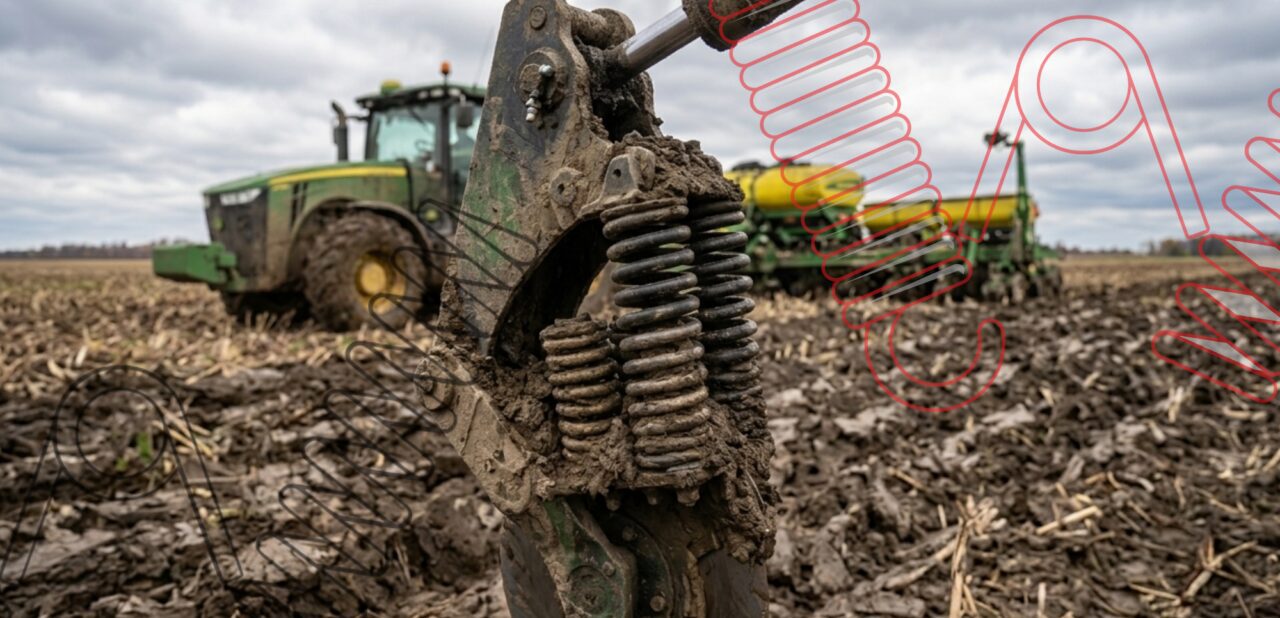
Optimizing spring design for farm machinery requires collaboration between spring manufacturers and equipment designers. Springs do not operate in isolation. They are part of larger mechanical systems, and their performance affects the behavior of the entire system. A row unit spring that is too stiff prevents the unit from following ground contours accurately. A spring that is too soft allows the row unit to bounce, reducing seed placement precision.
Spring design optimization begins with system-level analysis. Western Spring Manufacturing works with equipment engineers to understand how the spring interacts with surrounding components, what forces act on it during normal operation, and what failure modes are most critical to prevent. From that analysis, we develop spring specifications that improve system performance and meet the reliability requirements of the application.
The Role of Prototyping and Testing
Bringing a new agricultural spring design from concept to production involves a prototype and test phase that validates the design before committing to full production. Prototype springs are manufactured to the design specification, installed in equipment or test fixtures, and evaluated under simulated or actual field conditions.
Testing reveals how well the spring design performs against its requirements and identifies any issues that need to be addressed before production. Load testing confirms spring rate and maximum load capacity, while fatigue testing evaluates how the spring performs over repeated load cycles. Environmental testing exposes the spring to the corrosive conditions it will encounter in the field.
This process produces a high-quality, field-validated spring design that meets the performance and durability requirements of the application.
The Trusted Partner For Agricultural Spring Design
Western Spring Manufacturing: Our Approach
Agricultural spring design is a discipline that demands deep knowledge of materials, manufacturing processes, and the unique conditions that farm equipment must endure. At Western Spring Manufacturing, we bring four generations of spring manufacturing experience to every custom agricultural spring we produce.
Our ISO 9001:2015 certification reflects our commitment to quality in every step of the design and manufacture process. We have a membership with the Spring Manufacturers Institute, which enables us to stay updated on the latest developments in spring engineering and technology. We use advanced CNC coiling equipment and computerized testing systems to ensure that every spring we produce meets its design requirements with consistent accuracy.
Whether you’re designing a new piece of agricultural equipment or searching for a more reliable replacement spring for an existing system, Western Spring Manufacturing has the engineering capability and manufacturing experience to deliver a spring design solution built for the field.
Contact Western Spring Manufacturing to discuss your agricultural spring requirements, or explore our full range of spring products:
We build springs that work as hard as the equipment they are part of, because we understand that in agriculture, reliable components aren’t a luxury. They’re a requirement.