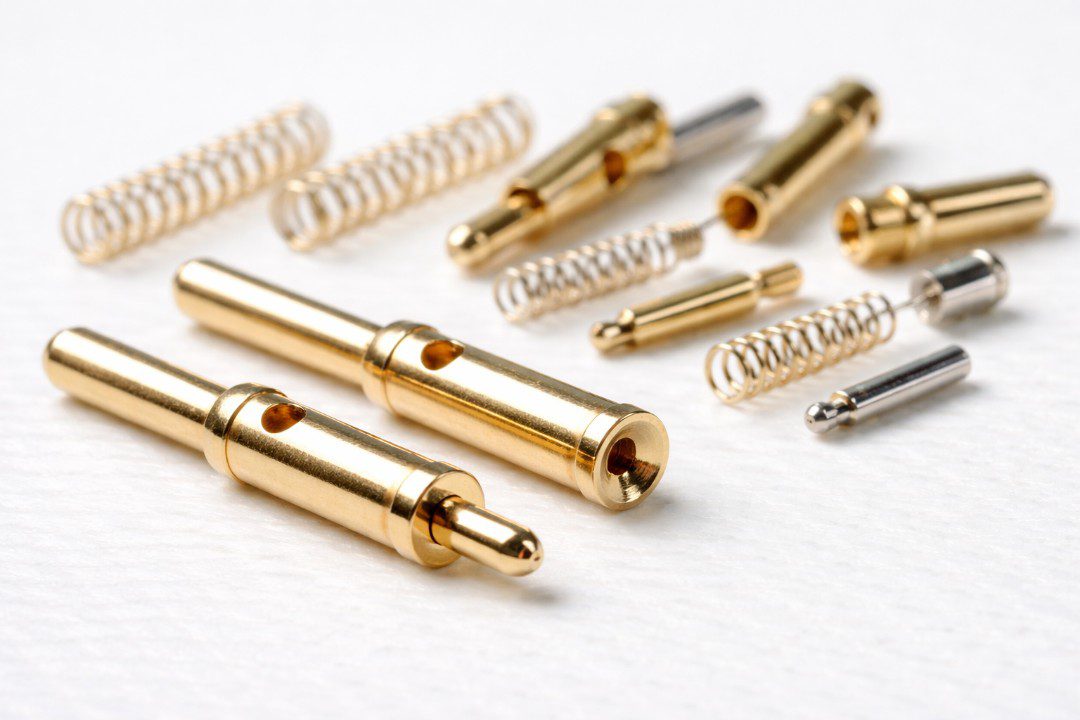
Pogo pins are among the most versatile and reliable electrical connector solutions in modern electronics. Found in everything from wearable fitness trackers to semiconductor test equipment, these small spring-loaded connectors deliver consistent electrical contact across thousands of mating cycles without the complexity of traditional mechanical fasteners.
If you’re designing a circuit board assembly, sourcing connectors for a medical device, or evaluating pogo pin manufacturers for a custom application, it’s important to understand how these components work and where they perform best.
Create an electrical connection
What Are Pogo Pins?
A pogo pin is a spring-loaded pin used to create a reliable electrical connection between two surfaces, typically a plunger-style contact pressing against a pad or plate on a mating surface. The name comes from the pogo stick toy, which shares the same compression-and-release mechanics that make these connectors work.
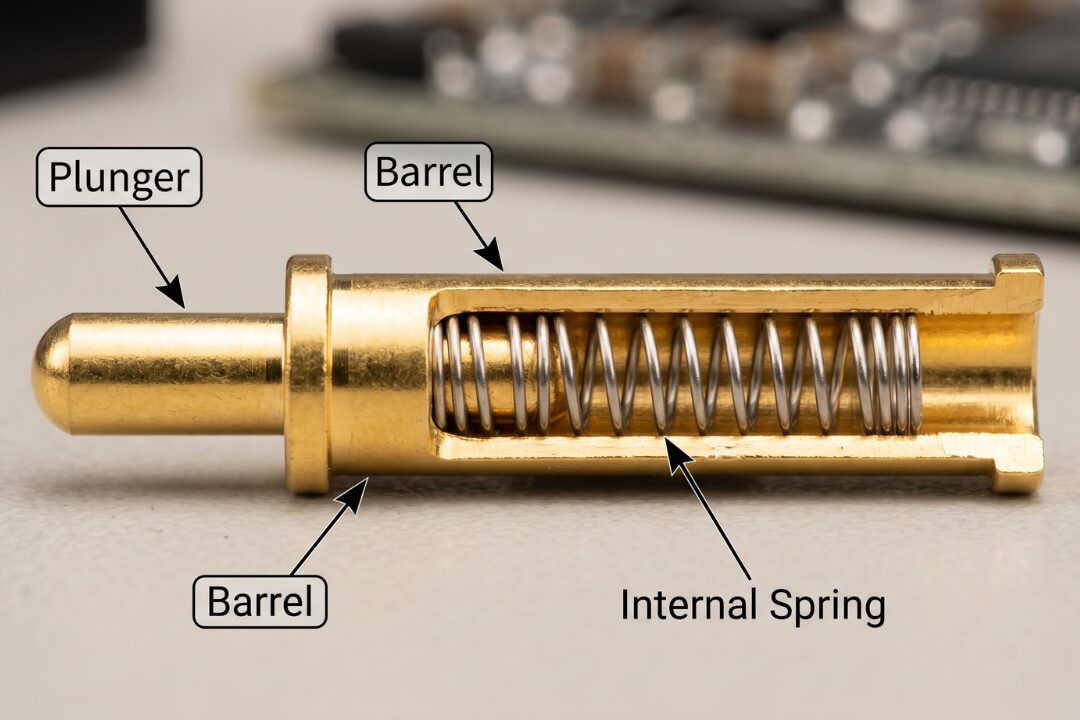
Each pin consists of three core parts: a plunger, a barrel, and an internal spring. The plunger extends outward from the barrel and compresses inward when it contacts the mating surface. The internal spring maintains consistent contact force across the full stroke of the plunger, ensuring the electrical connection stays stable even when components shift slightly during use.
This spring-loaded design is what separates pogo pins from static pin connectors. Rather than depending on a fixed mechanical connection, the spring inside the barrel continuously pushes the plunger against its contact pad, compensating for small dimensional variations, board flex, and surface irregularities in real time.
Look inside your connector
How the Spring-Loaded Pin Mechanism Works
The mechanics of a spring-loaded pin are straightforward, but the engineering behind making them reliable across thousands of mating cycles is more involved than it appears.
Plunger, Barrel, and Spring Interaction
When a pogo pin connector makes contact with its mating pad, the plunger travels inward along the stroke defined by the barrel geometry. The internal spring compresses under load, storing energy that pushes the plunger back outward when the contact surface is removed. This compression-and-recovery cycle is what gives spring loaded pogo pins their durability in high-cycle applications.
The stroke length, which is the total distance the plunger can travel from its extended position to its fully compressed position, is a critical design parameter.
Stroke configurations vary by application. For example, a pogo pin used in a consumer charging dock needs enough stroke to accommodate variation in docking alignment. A pin used in a precision test fixture may operate on a much shorter, more controlled stroke where positional accuracy is tightly managed.
Operating forces, which is the amount of force required to compress the plunger to its working position, are specified by pogo pin manufacturers and must be matched to the application. Light operating forces work well for delicate contact pads or assemblies where the mating device is positioned manually. Higher operating forces are appropriate for automated test equipment and industrial connectors where the assembly provides consistent mechanical force at each mate.
Contact Resistance and Conductivity
A pogo pin’s ability to maintain low contact resistance across its life cycle is one of its most important performance characteristics. Contact resistance rises when the plunger surface oxidizes, wears down, or loses consistent contact with its mating pad. This is why the plunger and barrel are typically made from brass or copper alloys selected for both conductivity and spring-force compatibility, then finished with a surface coating, often gold or nickel, to resist corrosion and preserve conductivity over time.
A gold-plated pogo pin contact surface maintains reliable electrical conductivity in harsh environments unlike base metal finishes that would oxidize. Nickel underplating is commonly applied beneath the gold layer to prevent base metal migration to the surface and extend service life. The plated area of the contact tip is typically the most critical surface on the entire pin, and manufacturers specify coating thickness as part of the product’s technical support documentation.
Understand how to choose the right design
Pogo Pin Design Variations
Pogo pin design variations cover a wide range of form factors, mounting styles, and electrical configurations. Selecting the right design starts with understanding the mounting method, the signal type, and the space available on your circuit board or assembly.
Mounting Styles
Surface Mount (SMT)
Surface mount pogo pins are soldered directly onto a PCB pad layout using standard reflow processes. Surface mount pogo pin connectors are a common choice in compact consumer electronics where board space is limited and connector height must be minimized. SMT variants are available in single-pin and connector arrays, making them adaptable to both simple two-point contacts and multi-signal board-to-board interconnect designs.
Through-Hole Mount
Through-hole pogo pins pass through a drilled hole in the PCB and are soldered from the bottom side. This mounting style provides a more robust mechanical connection to the board and is often preferred in applications where vibration loads could stress a surface-mounted joint. Through-hole mounting also makes it easier to achieve precise positional alignment across a multi-pin array.
Wire Mount
A wire mount pogo pin connects directly to a wire rather than a circuit board. This configuration is used when the connector must reach a contact point that isn’t accessible from a PCB, or when the design routes signals through a cable rather than a board trace. Wire mount variants are common in handheld test equipment and portable charging accessories.
Right Angle
Right angle pogo pin variants orient the plunger perpendicular to the board plane, allowing contact along the edge or side of an assembly rather than from the top surface. Right angle configurations are useful in tight enclosures where vertical pin access isn’t possible.
Threaded Mount
A threaded pogo pin uses a thread on the barrel to secure the pin into a matching receptacle or housing. This mounting style is common in test fixtures and industrial connectors where the pin must be individually replaceable without reworking the board or assembly.
Plunger Tip Geometries
The tip geometry of the plunger affects how reliably the pin makes contact with its mating pad. Flat tips distribute contact force across a larger plated area and are suitable for flat, smooth contact pads. Pointed or crown tips concentrate force at a smaller point, which helps penetrate surface oxides or film contamination on pads that see repeated mating cycles. Serrated or multi-point crown tips are common in spring probes used for circuit board testing, where breaking through surface contamination quickly is important for test accuracy.
Current and Signal Ratings
Pogo pin connectors are available across a wide range of current ratings, from miniature signal-level pins carrying milliamp-level signals to larger power pins rated for several amps. Selecting the right amp rating for your application is a fundamental step in the design process. Undersizing the current rating relative to actual load will cause the pin to heat, which accelerates both contact wear and spring fatigue inside the barrel.
For signal integrity in high-frequency applications, coaxial pogo pin configurations are available. These surround the central signal contact with a grounded shield, reducing interference and maintaining signal quality across the interconnect at frequencies where a standard pin would act as an antenna.
Unlock their vast potential
Pogo Pin Applications Across Industries
Pogo pin applications span nearly every sector of electronics, from consumer products to safety-critical industrial and medical systems. The common thread across all of them is the need for a solderless, repeatedly mateable electrical connection that holds up across many cycles without degrading.
Consumer Electronics and Wearables
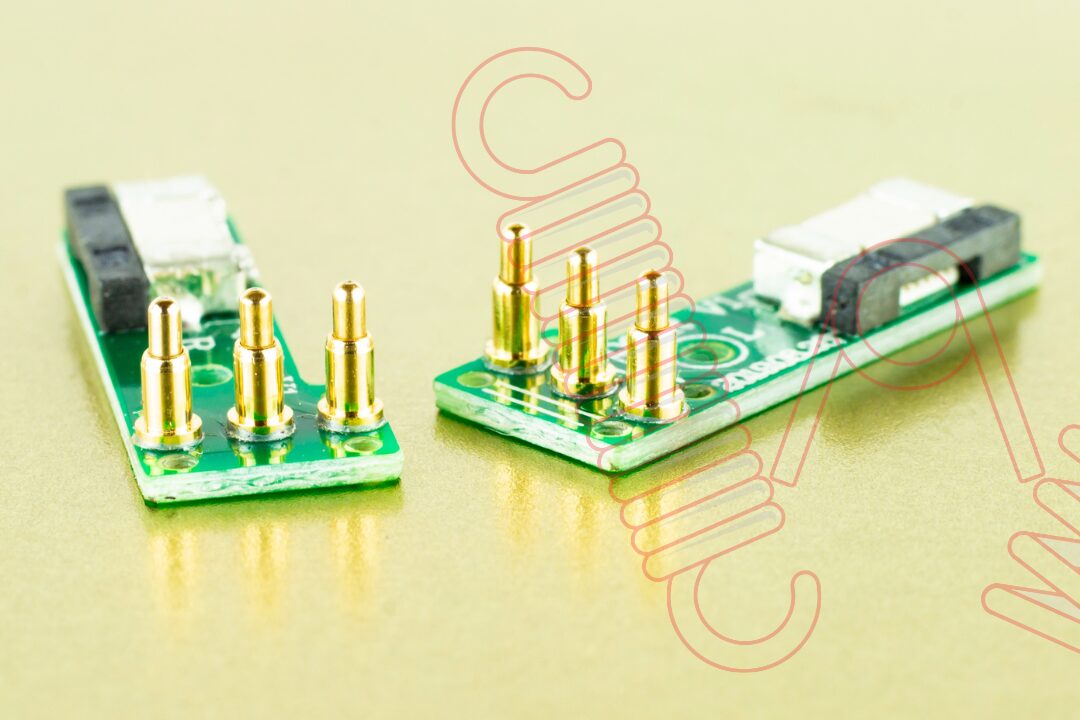
Many modern electronic applications in the consumer space rely on pogo pins for charging and data transfer. Smartwatches, fitness trackers, earbuds, and portable charging cases all use pogo pin connectors to establish a reliable electrical connection between the device and its charging cradle without an exposed plug or socket. This approach improves the device’s water resistance, reduces wear on the connection point, and makes the user experience simpler by eliminating the need to align a plug.
Magnetic pogo pin connectors take this further by pairing the spring-loaded contact with a magnetic alignment feature. The magnetic force draws the device into the correct position automatically, ensuring the plunger contacts the correct pad on every mate without user effort. Magnetic variants are found across a wide range of portable and wearable products where misalignment during docking would otherwise be a reliability concern.
Pogo Pin Usage in Testing Equipment
Pogo pin usage in testing equipment is one of the most technically demanding application categories in the industry. Test fixtures for circuit boards, semiconductors, and electronic assemblies rely on dense arrays of spring-loaded pins to make simultaneous contact with dozens or hundreds of test points on a board under test.
In a bed-of-nails fixture, each pin in the array contacts a specific pad or through-hole on the circuit board. The fixture compresses all pins simultaneously, making complete electrical contact across the entire board in a single mate cycle. This approach allows automated test equipment to test every net on the board in seconds rather than probing each point individually.
Spring probes used in semiconductor testing operate at particularly tight tolerances, where contact resistance, positional accuracy, and cycle life are all specified to demanding levels. A single test fixture may contain hundreds of pins, each of which must perform identically across tens of thousands of test cycles to deliver consistent, repeatable test results.
Pogo Pins for Medical Devices
Pogo pins for medical devices must meet requirements that go beyond the performance standards applied in consumer or industrial applications. Medical pogo pin connectors must maintain high reliability over the device’s service life, resist corrosion from cleaning agents and sterilization processes, and meet regulatory requirements for biocompatibility when used in or near patient contact areas.
A pogo pin used in an implantable or wearable medical device carries the same basic structure as a standard pin, but the material selection, surface coating, and manufacturing tolerances all reflect the more demanding environment. Gold plating over a base metal selected for both conductivity and biocompatibility is a common configuration in medical contact design. Miniature pin formats allow pogo pins for medical devices to fit within the tight spatial constraints of modern portable medical equipment.
Industrial and Automotive Applications
Industrial pogo pins must handle mechanical shock and vibration levels that would loosen or damage static connectors over time. The continuous contact force provided by the internal spring makes pogo pin technology well-suited to vibrating machinery, vehicle-mounted electronics, and automation equipment that sees constant movement during operation.
In automotive charging and data transfer applications, pogo pins are used in seat and console-mounted device charging pads, vehicle diagnostic connectors, and module-to-module interconnect solutions where repeated mate and unmate cycles are part of normal vehicle operation. The durability and resilience of the spring-loaded connector in these environments makes it a practical alternative to traditional socket connectors that wear at their contact points with each insertion.
Ready to spec the right spring for your pogo pin design? Contact our engineering team.

Engineering support to prototype your design
Custom Pogo Pins and Design Considerations
Standard catalog pogo pins cover the needs of many applications, but custom pogo pins are the right answer when your design has requirements that fall outside standard configurations.
Custom pin design begins with defining the functional requirements: current rating, operating forces, stroke, mounting method, plunger tip geometry, and any special material or coating requirements driven by the application environment. From those requirements, a manufacturer develops a design that meets the electrical and mechanical specifications while fitting within the space available on your board or assembly.
Custom connector arrays, meaning multi-pin housings with integrated pogo pin contacts, allow designers to combine multiple signals, power rails, and grounds into a single connector footprint. This approach simplifies board design, reduces the number of separate connector components, and can make pad layouts easier to manage on both sides of the connection.
Working with pogo pin manufacturers that offer engineering support early in the design process helps avoid costly revisions later. Factors like plunger stroke relative to assembly tolerance stack-up, recommended working compression range, and the relationship between contact force and contact resistance all benefit from a detailed design review before tooling is finalized. Confirming pricing and lead time for custom configurations early in the program keeps procurement timelines realistic alongside the engineering schedule.
How Western Spring can support you
Choosing the Right Pogo Pin Connector
Selecting a pogo pin connector for your application comes down to matching the pin’s design parameters with system requirements.
Start with the electrical requirements: the current the pin must carry, the signal frequency if applicable, and the contact resistance budget your circuit can tolerate. These drive material selection, plating specification, and pin size.
Next, review the mechanical requirements: the stroke available in your assembly, the operating forces your structure can apply and absorb, the mounting style your board supports, and the vibration or shock environment the connector will see in service.
Consider the cycle life the application demands. A charging dock pin that mates and unmates multiple times a day needs a different cycle specification than a test fixture pin that cycles thousands of times per shift. Pogo pin manufacturers publish cycle life ratings for their standard products, and custom designs can be specified to match the target cycle count for your program.
Finally, confirm that the connector fits within your board layout and assembly process. Surface mount pins offer the simplest assembly path when your board supports reflow. Through-hole and wire mount options add process steps but provide stronger mechanical attachment when your application requires it. For assemblies where the pin must be field-replaceable, threaded receptacle configurations let service teams swap individual pins without board rework.
Need a precision spring for a custom connector? Let’s talk.
Western Spring Manufacturing has been producing custom springs and pogo pins for engineers across North America since 1909.
Pogo pins are precision spring components. The internal spring inside every barrel is what makes the connector work, and the quality of that spring determines how consistently the pin performs across its full service life.
At Western Spring Manufacturing, we bring four generations of spring engineering expertise to every component we produce, including the precision springs at the heart of spring-loaded connectors and custom pin assemblies. Our ISO 9001:2015 certification and Spring Manufacturers Institute membership mean the springs inside your pogo pin connectors are manufactured to documented quality standards and verified with computerized force/length testing before they leave our facility.
Whether you need standard spring components for a pogo pin assembly or fully custom spring solutions for a unique connector design, our engineering team is ready to help you get from design to production with the technical support your program needs.
Contact Western Spring Manufacturing today to discuss your application requirements and find out how our precision spring manufacturing can support your next pogo pin or spring-loaded connector project.