E-coating is a process that many manufacturers rely on when a spring or wire form needs a durable, uniform coat that liquid paint or powder can’t always deliver on complex shapes. If you’re weighing finishing options for a custom part, understanding how e-coating works can help you decide if it’s the right fit.
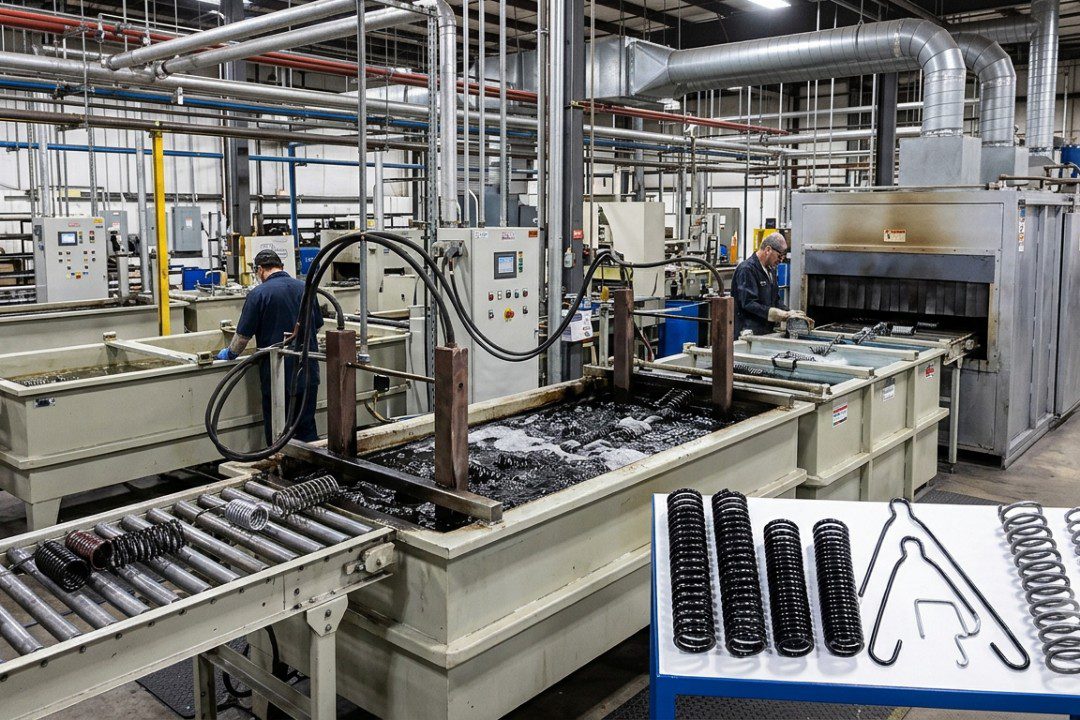
Electro-deposition coating, often called e-coat or electrocoat, is a process that uses an electrical charge to deposit paint particles onto a metal substrate. Rather than spraying paint onto the surface of a part, e-coating submerges the component in a bath filled with paint solids suspended in water. Voltage is applied, and the charged paint particles migrate to the surface of the part, forming an even coat across every reachable area, including hard-to-reach spots that spray or dip methods often miss.
The Process
How the E-Coating Process Works
The e-coating process involves several distinct steps, each one contributing to the final coating thickness, adhesion, and durability of the finished part. From cleaning to cure, every stage is controlled to produce a consistent, defect-free finish.
Pretreatment and Cleaning
Before any part enters the e-coat bath, it goes through a pretreatment stage to clean the surface and prepare it for coating. This often includes phosphating, a chemical process that improves adhesion between the metal and the coating that follows. Proper pretreatment matters just as much as the e-coat application itself, since a poorly cleaned surface can lead to uneven coverage or early coating failure.
Immersion in the E-Coat Bath
Once cleaned, the part is submerged in the e-coat bath. This immersion step is what sets electrodeposition coating apart from spray-applied finishes. Because the part is fully submerged, paint reaches every surface evenly, even complex geometries like coiled springs or bent wire forms that would be difficult to coat consistently with a spray gun.
Curing the Coat
After the part comes out of the bath, it’s baked in an oven to cure the coating. This bake step causes the film to harden and bond tightly to the substrate, forming a tough, durable finish. Coating thickness is closely controlled during this process to make sure every part meets the same film thickness specification, batch after batch.

Types of E-Coat
Types of Electrocoat Used for Springs and Wire Forms
Not all e-coat is the same, and the type used depends on the application, the substrate, and the level of corrosion resistance needed. Understanding the differences can help you choose the right coating solutions for your project.
Cathodic and Anodic Electrocoat
Cathodic epoxy electrocoat is one of the most common types used in industrial and automotive applications, known for strong corrosion protection and chemical resistance. Anodic epoxy electrocoat is another option, often used where cost is a bigger factor than maximum durability. A cathodic acrylic electrocoat is also available for applications where UV resistance and color stability matter more than the added toughness of epoxy.
Each of these coating types is compatible with different topcoat materials, so the right choice often depends on whether the part needs a topcoat for additional color options or protection, or whether the e-coat alone will serve as the final finish.
Why It’s Used
Benefits of E-Coating Springs and Wire Forms
E-coating springs and electro-deposition coating wire forms both offer a handful of advantages that make this process a popular choice for parts that need reliable, even coverage.
Uniform Coverage on Complex Shapes
Because e-coating relies on immersion rather than spray application, it deposits coating evenly across the entire part, including the inside of coils and tight bends in wire forms. This is a major advantage for wire forms, since spray painting can leave thin spots or gaps in areas that are hard for a spray gun to reach.
Corrosion Resistance and Durability
E-coat provides strong corrosion resistance, particularly when paired with a phosphate pretreatment and a cathodic epoxy electrocoat. Parts finished with e-coat often perform well in salt spray testing, making this process a solid choice for springs and wire forms headed to outdoor or high-moisture environments.
Environmentally Friendly Process
E-coating is considered an environmentally friendly finishing option compared to some liquid paint processes, since the paint bath uses water as a carrier rather than solvents, and any excess paint solids can often be reclaimed and reused rather than wasted.
E-Coat vs Other Finishing Options
Comparing E-Coat to Powder Coating and Liquid Paint
E-coat is one of several finishing options available for springs and wire forms, and it’s worth understanding how it compares to powder coating and traditional liquid paint.
Powder coating uses an electrostatic charge to apply dry powder to a part’s surface, then cures it under heat, similar in concept to e-coating but without the immersion step. Powder coating can achieve a thicker coat than e-coat and offers more flexibility for custom colors, but it doesn’t reach hard-to-reach interior surfaces as effectively as an e-coat bath does. Liquid paint applied by spray is generally the least expensive option, but it often falls short on uniform coverage and long-term durability compared to e-coat or powder.
For parts that need a topcoat for added color or UV protection, e-coat is often used as a primer layer underneath, combining the corrosion resistance of electrodeposition with the appearance benefits of topcoat paint.
Applications for E-Coated Springs and Wire Forms
Where E-Coating Is Used
E-coating springs and wire forms shows up across several industries where durability, even coverage, and corrosion resistance are critical.
Automotive components often rely on e-coat as a primer technology before a topcoat is applied, giving parts strong adhesion and long-term protection against rust. Defense and agricultural equipment also benefit from the toughness and corrosion protection e-coating provides, particularly for parts exposed to harsh field conditions. Industrial machinery components that need a clean, uniform coat across complex shapes are another common application for this process. Our team supports automotive and defense customers with finishing solutions built around these needs.

Next Steps
Partner with Western Spring for E-Coating Solutions
Western Spring works with customers to identify the right coating process for their springs and wire forms, whether that’s e-coat, powder coating, or another finishing method entirely. As a fourth-generation, family-owned manufacturer with ISO 9001:2015 certification, we help customers outsource finishing decisions with confidence.
Reach out to our team today to talk through your e-coating project, and we’ll help you find a coating process that fits your part, your application, and your budget.