Selecting the right spring for your application is not simply a purchasing decision. It’s an engineering one.
Whether you’re developing a new product, replacing worn components on a production line, or building a prototype, the choice between custom and stock springs directly shapes your project’s cost structure, performance envelope, and delivery timeline. If you’re still defining performance requirements, Western Spring offers spring design assistance to help you evaluate fit, load, material, and manufacturing constraints early in the process.
This guide breaks down the real differences between the two options so you can evaluate your requirements with confidence and avoid costly specification errors.
Choosing Your Spring Solution
The Difference Between Custom Springs and Stock Springs
Stock springs are pre-manufactured components produced to industry-standard dimensions and tolerances. They are available from distributors and catalogs in common configurations, including fixed wire diameters, outer coil diameters, free lengths, spring rates, and end types. These standardized components are built for general-purpose use across a wide range of applications where exact performance parameters are not critical. You can explore Western Spring’s full range of spring products to see how standard product categories compare to more application-specific solutions.
Custom springs are designed and manufactured to your exact specifications. Wire diameter, coil diameter, free length, spring rate, material, surface finish, and end configurations are all defined by your application’s requirements. At Western Spring Manufacturing, every custom spring is verified against your specified parameters using computerized force/length testing equipment before it ships. The distinction between the two options becomes most significant when your design pushes against the limits of standard catalog geometry, or when tight tolerances directly affect product function and safety.
| Factor | Stock Springs | Custom Springs |
|---|---|---|
| Availability | Catalog and distributor inventory | Built to your application requirements |
| Lead Time | Often ships in a few business days | Requires design review, tooling, inspection, and production |
| Initial Cost | No tooling investment | Tooling and setup costs may apply |
| Per-Unit Cost at Volume | Often higher at production volume | Can decrease once tooling is amortized |
| Geometry Options | Limited to standard sizes and end types | Defined by your exact specifications |
| Material Options | Limited to common spring materials | Can match corrosion, temperature, medical, or fatigue requirements |
| Tolerances | Standard catalog tolerances | Can be engineered for tighter performance requirements |
| Testing and Documentation | Usually limited | Can include force testing, material certifications, and traceability |
| Best Fit | Maintenance replacement, early prototypes, general use | Production applications with strict load, fit, life, or compliance requirements |
Custom Spring Variations
Customization Variables That Define Spring Performance
A meaningful comparison between custom and stock springs starts with understanding what controls each spring type’s performance.
When your application requires precise control over spring geometry, rate, material, or end configuration, working with a team that offers spring design assistance early in development can reduce redesign work and help you move toward production with confidence. For a deeper overview of specification planning, Western Spring’s guide to custom spring design specifications is a useful companion resource.

Compression Springs
Compression springs resist axial compressive loads and return to free length when the load is removed. The design variables that govern their performance include:
- Wire diameter (d): Affects stress levels and spring rate
- Mean coil diameter (D): Determines the spring index (D/d), which influences coilability and fatigue life
- Number of active coils (Na): The primary variable controlling spring rate
- Free length (Lf): Sets the unloaded geometry of the spring
- Spring rate (k): Governed by spring material and geometry
Stock compression springs are available in a limited set of wire diameters, coil diameters, and free lengths. If your required spring rate, working height, or load capacity falls outside standard catalog values by an amount your application cannot tolerate, a custom spring is the correct path. You can review more product details on Western Spring’s compression springs page or learn more about sizing considerations in this guide to wire diameter selection.

Extension Springs
Extension springs store energy when stretched and apply a return force proportional to deflection. Beyond the rate variables they share with compression springs, extension springs add two design-specific considerations:
- Initial tension: The built-in preload that must be overcome before the spring starts to extend
- End type: Standard hooks, extended hooks, short hooks, side hooks, or fully custom ends
- Body diameter and active coils: These affect rate, stress, and load response
Applications with specific attachment interfaces or unusual hook clearance requirements often cannot be served by standard catalog end configurations. Western Spring’s extension spring manufacturing capabilities allow tighter control over these details.

Torsion Springs
Torsion springs apply a torque when rotated about their axis. Angular spring rate is governed by wire diameter, coil diameter, and active coil count, adjusted to account for leg geometry. Additional design variables include:
- Leg length and orientation: Define how the spring interfaces with your assembly
- Direction of wind: Left-hand or right-hand wind must match your direction of applied torque
- Angular rate: Calculated from coil and wire geometry
If your required torque-at-angle falls between catalog offerings, you need a custom spring. Western Spring’s torsion spring manufacturing options let you specify leg length, bend angle, and end style to match your mounting exactly.

Die Springs
Die springs are designed for high-load, high-cycle use in tooling, stamping, and heavy industrial applications. Their performance is shaped by:
- Material strength: Supports repeated compression under high stress
- Load class: Determines how much force the spring can deliver within a given space
- Cycle requirements: Affect fatigue design and processing requirements
When standard die spring load classes or dimensions do not align with your assembly, custom design gives you more control over service life and fit. Learn more on Western Spring’s die springs page.
Flat Springs
Flat springs are used in applications where force, deflection, and profile geometry need to fit within a compact form. Key variables include:
- Material thickness and width: Affect stiffness and load capacity
- Profile shape: Defines how force is distributed through the part
- Surface finish: Influences wear resistance and fatigue performance
Flat springs are often application-specific parts, which makes custom production the preferred route. Western Spring’s flat spring manufacturing capabilities support custom geometry and demanding performance requirements.

Counter Balance Springs
Counter balance springs, sometimes called clock springs, are designed to deliver controlled torque across a range of motion. The main customization variables include:
- Strip thickness and width: Affect torque output and stored energy
- Number of turns: Defines travel range and energy capacity
- Housing and arbor geometry: Must align with the assembly layout
These springs are commonly engineered around the motion profile and available packaging space of the finished product. Review Western Spring’s counter balance spring options for more detail.

Medical Coils
Medical coils are precision-made components used in applications where consistency, cleanliness, and material control are critical. Performance depends on:
- Wire diameter tolerances: Must be tightly controlled for repeatable function
- Material selection: Often requires specialty alloys suited for medical environments
- Surface quality and cleanliness: Important for packaging, handling, and end use
Medical applications often require custom manufacturing, documentation, and validated processes that stock springs cannot provide. Western Spring’s medical coil manufacturing page explains these capabilities in more detail, and their medical industry page gives more context on requirements for regulated applications.

Wire Forms
Wire forms are not always classified as springs, though they often serve related mechanical functions such as retaining, guiding, positioning, or transferring force. Their performance is defined by:
- Part geometry: Bends, radii, and angles determine function
- Material properties: Influence strength, flexibility, and corrosion resistance
- Tolerances: Control fit and repeatability inside the assembly
Wire forms are usually fully custom components built around a specific function. Western Spring’s wire form manufacturing services support both simple and complex geometries.
If your application requires a spring or wire form that falls outside catalog dimensions, Western Spring can help you move from concept to production through design assistance, design print submission, and a direct request for estimate.
Custom isn’t always better
When Stock Springs Are the Right Choice
Stock springs make practical sense in specific, well-defined situations. They are a legitimate engineering choice when the application genuinely fits a standard specification, not just a fallback option.
Stock springs are a sound choice when your application can accommodate the dimensional range available in standard catalogs without performance compromise, your required spring rate and load-at-height fall within what catalog springs can deliver, your operating environment does not demand materials outside common stainless or hard-drawn carbon steel options, you need replacement springs for maintenance applications where the original part matches a standard size, or you are in early prototype development and need a near-match to validate a mechanism before committing to custom tooling investment. In replacement scenarios, it can help to review relevant product categories such as compression springs and Western Spring’s maintenance and repair capabilities.
The practical trade-off with stock springs is working within fixed parameters. If your design can accept that constraint, you save both tooling cost and lead time. For assemblies already in service, Western Spring’s article on when to replace springs is another good reference point.
How Western Spring Can Support You
When Custom Springs Are the Right Choice
Custom springs are the right call when your application imposes requirements that no standard catalog part can meet. These conditions consistently point toward custom manufacturing:
Your required spring rate falls between standard catalog values and the performance gap is not acceptable. Your space envelope demands non-standard coil geometry, a specific free length, or an outer diameter that does not appear in catalogs. Your application requires a specialty material for corrosion resistance, elevated-temperature performance, or biocompatibility, such as 17-7 PH stainless, Elgiloy, Inconel, or titanium. Your load and deflection requirements demand tight rate tolerances, such as ±5% or tighter, that catalog springs do not carry. Your application involves aerospace, defense, or medical end use, where material traceability, lot certification, and documented testing are part of the specification. Your production volume is sufficient to offset tooling investment and reduce per-unit cost below catalog pricing.
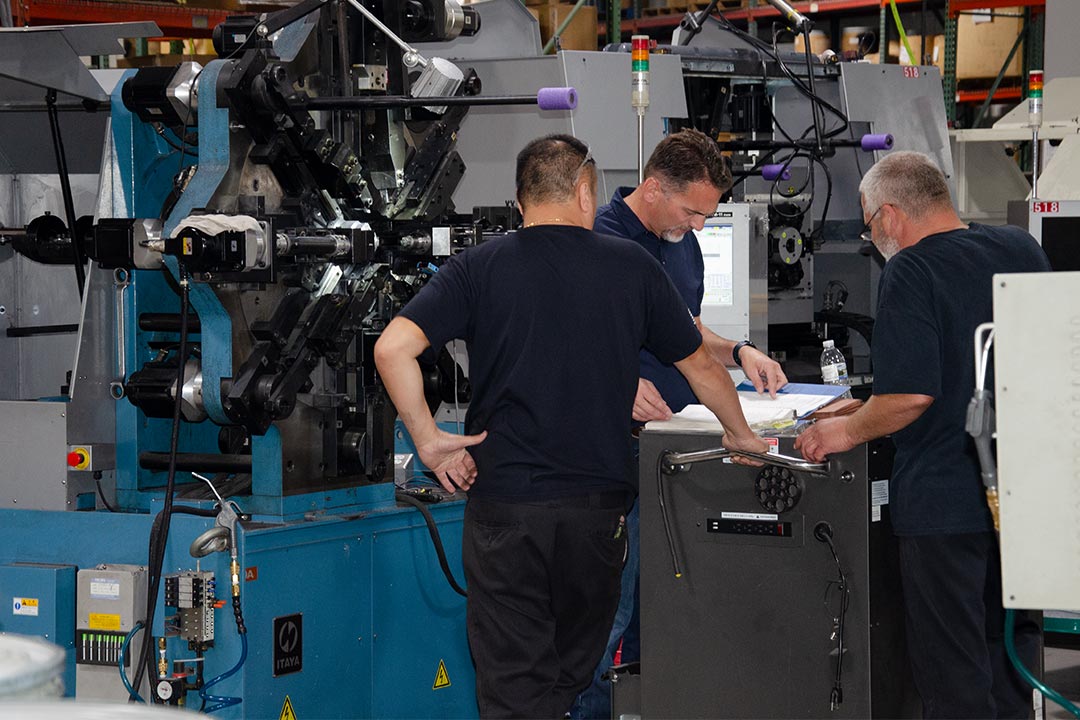
Western Spring Manufacturing’s engineering team works with you from specification through production, using spring design software to model geometry and performance before tooling is cut. Computerized force/length testing at delivery confirms that every spring matches your specifications. If you already have drawings or part requirements prepared, you can submit a design print for review or request an estimate to start the quoting process.
Cost Analysis: Custom vs. Stock Springs
Cost comparisons between the two options require looking beyond the unit price on a distributor’s quote. Western Spring’s services page gives a clearer picture of the support that comes with engineered spring production.
Stock spring costs are predictable. You pay catalog price with no tooling fees, no engineering time, and no minimum quantities beyond the distributor’s standard requirements. For low-volume applications or maintenance procurement, this is typically the lower-cost option at the unit level.
Custom spring costs include an upfront investment in tooling and, in some cases, design engineering time. That investment is amortized across the production run. At sufficient volume, per-unit cost for a custom spring can fall below catalog pricing. The spring is manufactured directly to your specifications rather than adapted from a standard part.
Two additional cost factors often go unaccounted in a simple unit-price comparison. First, the cost of adapting your design to fit a non-ideal stock spring: engineering workarounds, modified mounting hardware, or added assembly complexity to accommodate the wrong spring geometry carry real labor and material costs. Second, long-term replacement frequency. A custom spring sized to operate within its optimal stress ratio for your cycle requirement will have a longer service life than a stock spring running outside its design envelope. Reduced failure rates lower replacement frequency, unplanned downtime, and total lifecycle cost. This same issue is discussed from another angle in Western Spring’s post on why in-house spring coiling is almost never the right choice.
Lead Time: What to Plan For
Lead time is a legitimate planning variable, and both options carry different timelines.
Stock springs ship from distributor inventory, often within a few business days. For urgent maintenance applications or fast prototype builds, that speed is a real advantage. The trade-off is dependence on what is currently stocked. Distributor inventory can have gaps, and lead times can extend if a common size is temporarily out of stock.
Custom springs require design confirmation, tooling fabrication, first-article inspection, and a production run before shipment. Timelines vary with spring complexity, material availability, and production schedule. The most common mistake engineers make is treating custom spring lead time as an afterthought late in the design process. Engaging Western Spring Manufacturing early in development allows the team to stage tooling and material acquisition in parallel, compressing the timeline where possible. Starting with design assistance or a spring prototyping and design review can make that planning process much smoother.
If your product launch date or production ramp has a firm deadline, the time to start a custom spring conversation is at the design phase, not after your prototype is locked in.
Performance Engineering: Where the Difference Becomes Clear
Performance differences between custom and stock springs are most apparent under demanding operating conditions. The variables below illustrate why a purpose-engineered spring outperforms a catalog part in critical applications.
Stress ratio and fatigue life. The ratio of your spring’s maximum operating stress to the material’s ultimate tensile strength (UTS) is the most direct predictor of fatigue life. A stock spring used at a stress level near its rated capacity will fatigue faster than a custom spring designed so your operating stress stays well within the material’s endurance range. Custom manufacturing lets your engineer set the stress ratio intentionally. Western Spring’s article on preventing spring failure gives more context on this issue.
Set removal. When a spring is compressed to solid height during manufacturing, initial set is removed and the free length stabilizes. This pre-setting step tightens dimensional performance in service, reducing variation between parts in the same lot. Pre-setting is a standard process option in custom production runs and is not available when selecting from catalog stock.
Shot peening. For high-cycle applications, shot peening the coil surface induces compressive residual stresses that resist fatigue crack initiation. This process step is available on custom production runs at Western Spring Manufacturing and can extend spring service life significantly in cyclic loading applications. Western Spring covers related processing methods in its spring treatments and finishing options resource.
Material selection. Wire material drives more than tensile strength. Shear modulus, fatigue performance, relaxation at temperature, and corrosion resistance all vary by alloy. Hard-drawn wire, music wire, 302/304 stainless, 17-7 PH stainless, chrome-silicon, and chrome-vanadium each carry different performance profiles. Custom manufacturing lets you match material selection to your actual operating environment rather than accepting whatever a catalog spring is wound from. Western Spring’s spring material options page is a good place to compare material categories.
How to Choose Between Custom and Stock Springs
Work through these questions to reach the right decision for your application:
- Does a standard catalog spring exist that matches your required spring rate, free length, wire diameter, and end type within the tolerances your application can accept?
- Does your operating environment, cycle count, or end-use industry impose material or documentation requirements that catalog springs cannot meet?
- At your projected production volume, does the tooling investment for a custom spring reduce your per-unit cost below catalog pricing?
- Are there space envelope constraints in your assembly that eliminate available catalog options?
- Are you early enough in your design cycle to specify custom spring geometry into the surrounding assembly, rather than designing around a catalog part after the fact?
If your answers point toward custom manufacturing, engaging a spring manufacturer at the design stage gives you the most flexibility. You can optimize spring geometry and material selection before the surrounding assembly is finalized, avoiding the common and costly problem of locking your design into a specification that a standard spring cannot serve. From there, you can move straight into design assistance or request an estimate for your application.
Western Spring Manufacturing has been producing custom springs and wire forms for engineers across North America since 1909.
As a 4th-generation family-owned business and ISO 9001:2015 certified manufacturer, we design and produce compression springs, extension springs, torsion springs, flat springs, wire forms, and specialty products to meet demanding specifications across aerospace, defense, medical, automotive, agricultural, and industrial applications.
Our team applies computerized spring design software and force/length testing equipment to verify that every spring we ship meets your specifications. Contact us to discuss your application requirements, submit a design print for review, or request an estimate to get started with the right custom solution.